Gujarat is one of India's most visited states. And somehow, it's also one of India's most unexplored.
Most people who come here follow the same path - Rann of Kutch, Gir, Ahmedabad. The highlights. And they're wonderful. But there's a parallel Gujarat sitting just off that route - quieter, stranger, older, and in many ways more extraordinary than what most tourists ever see.
A salt desert that turns pink with flamingos. A beach tied to one of mythology's greatest love stories. A stepwell so intricately carved it took UNESCO's breath away. A bird sanctuary 90 minutes from Ahmedabad that most people in the city have never visited.
These places aren't hard to reach. They're just waiting for someone to actually show up.
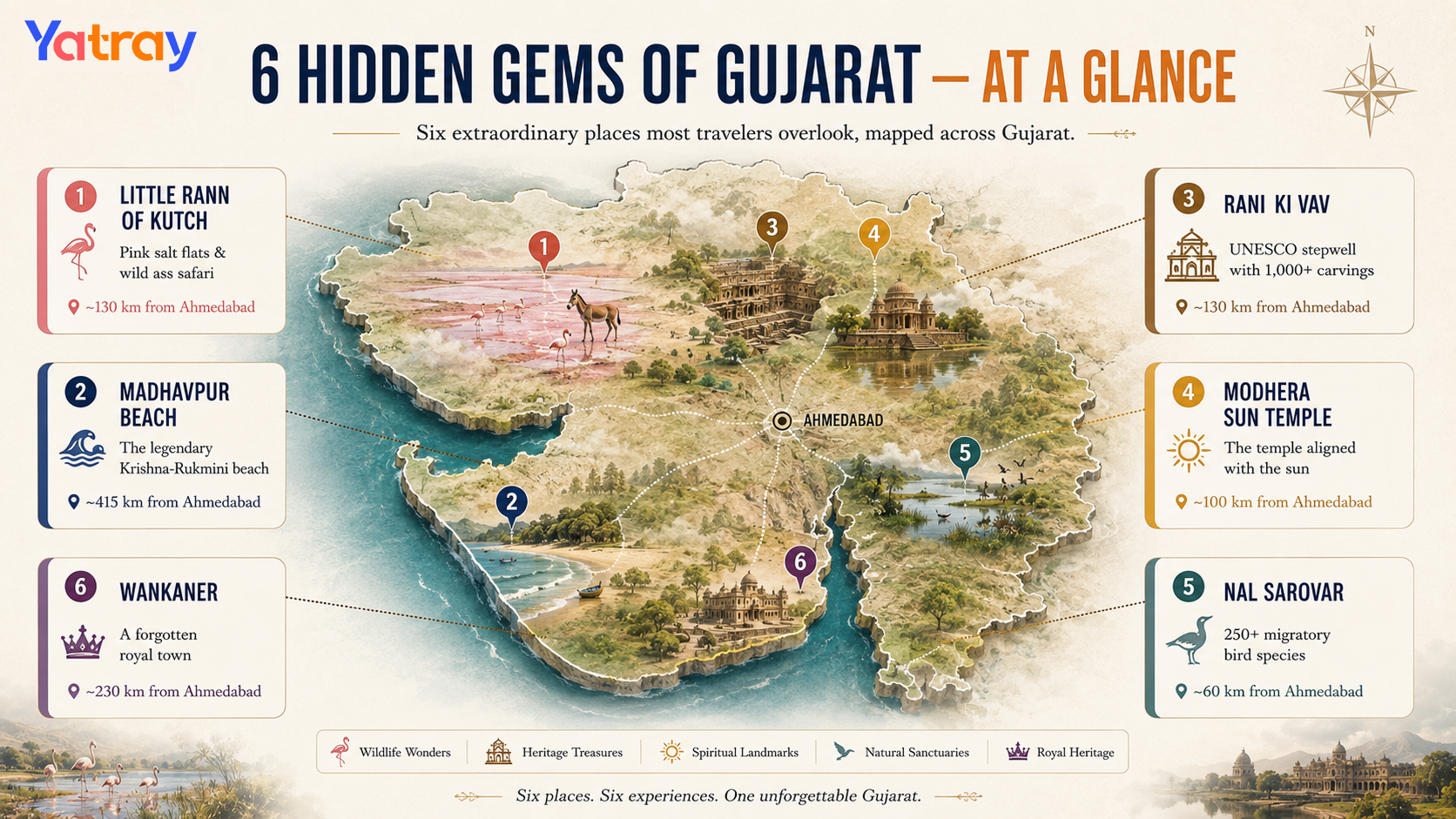
1. Little Rann of Kutch - When the Desert Turns Pink
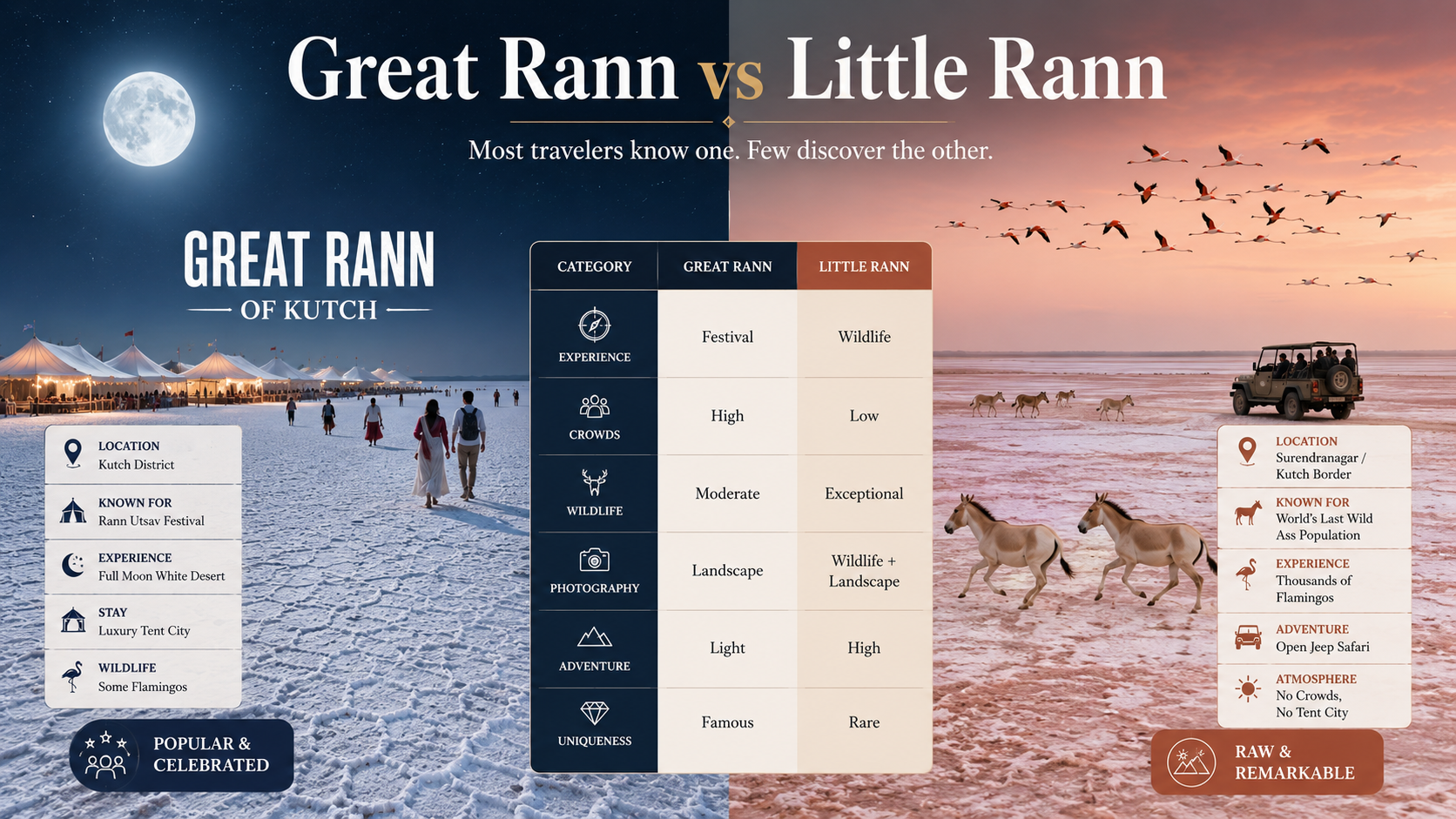
Most people have heard of the Rann of Kutch - the vast white salt desert in Gujarat's west. Few people realise there's a second, completely different Rann sitting 150 km to the east.
The Little Rann of Kutch covers 4,953 square kilometres and is home to something that exists nowhere else on earth: the last surviving population of the Indian Wild Ass (locally called Khur or Gudkar). About 6,000 of them live here - the entire global population of their species, in a single sanctuary.
Watching a herd of wild ass gallop across the salt flat at sunset - silhouetted against a horizon that stretches to infinity - is one of those travel moments that doesn't translate to photographs. You just have to be there.
But the wild ass isn't even the most visually dramatic part.
Every winter, the Little Rann's wetlands attract thousands of Greater and Lesser Flamingos. When they gather in large numbers, the salt flats literally turn pink. Combined with the stark white landscape, the wide sky, and the silence, it creates an image so surreal it looks digitally altered. It isn't.
The jeep safari experience here is completely different from Gir - no dense forest, no shade, no road. Just a vast open landscape, a knowledgeable local guide, and wildlife appearing from unexpected directions.
Getting there: The main entry point is Dasada village, about 130 km from Ahmedabad (~2.5 hours). Several eco-camps and safari operators are based here.
Best time: October to March. Peak flamingo season is December–February.
Best for: Wildlife lovers 🦁 · Photographers 📷 · Couples 💑 · Anyone who's been to Gir and wants something completely different
2. Madhavpur Beach - The Beach Where a God Got Married
Before you picture a packed beach with umbrellas and vendors - stop.
Madhavpur is nothing like that.
Located about 58 km from Porbandar on the Saurashtra coast, Madhavpur Beach is one of Gujarat's longest, cleanest, and most genuinely uncrowded stretches of coastline. Coconut palms, clear blue water, golden sand - and almost no one there.
But what makes Madhavpur different from every other beach in India isn't the landscape. It's the story.
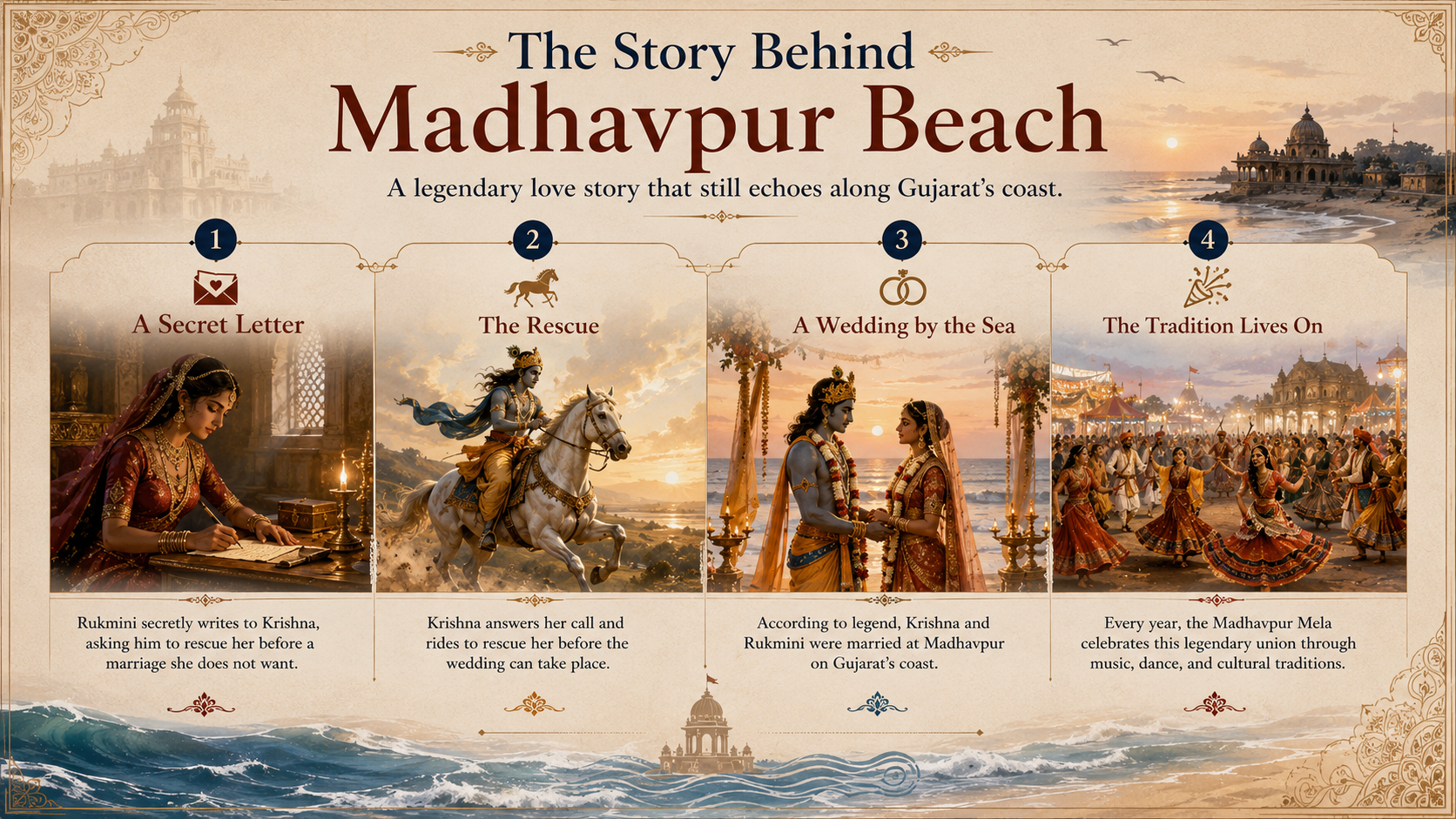
This beach is believed to be the site where Lord Krishna married Rukmini. According to legend, Rukmini - a princess of Vidarbha - sent a secret letter to Krishna asking him to rescue her before a marriage she didn't want. Krishna arrived, and they eloped together, eventually marrying here at Madhavpur. The Madhavraiji Temple nearby, originally built in the 15th century, is dedicated to this union. Its ruins from the original structure still stand alongside the rebuilt temple.
Every year during Madhavpur Mela - held in the Chaitra month (March–April) - the village comes alive with tribal dances, folk music, and rituals celebrating Krishna and Rukmini's marriage. Particularly special is the involvement of communities from Northeast India (especially Arunachal Pradesh), who consider themselves descendants of Rukmini's people - a remarkable convergence of two very distant Indian cultures at a small beach village in Gujarat.
Even without the festival, Madhavpur is just a beautifully calm place. Coconut water from beach vendors. Sunset over the Arabian Sea. The kind of quiet that cities make you forget exists.
Getting there: Madhavpur is on the road between Porbandar and Somnath - make it a stop on any Saurashtra road trip.
Best time: October to March. The Mela happens in March-April.
Best for: Couples 💑 · Mythology and culture lovers · Photographers 📷 · Road trippers 🚗
3. Rani ki Vav, Patan - A Stepwell Carved Like Jewellery
There is a stepwell in the town of Patan, in North Gujarat, that is so intricately carved it was added to the UNESCO World Heritage List.
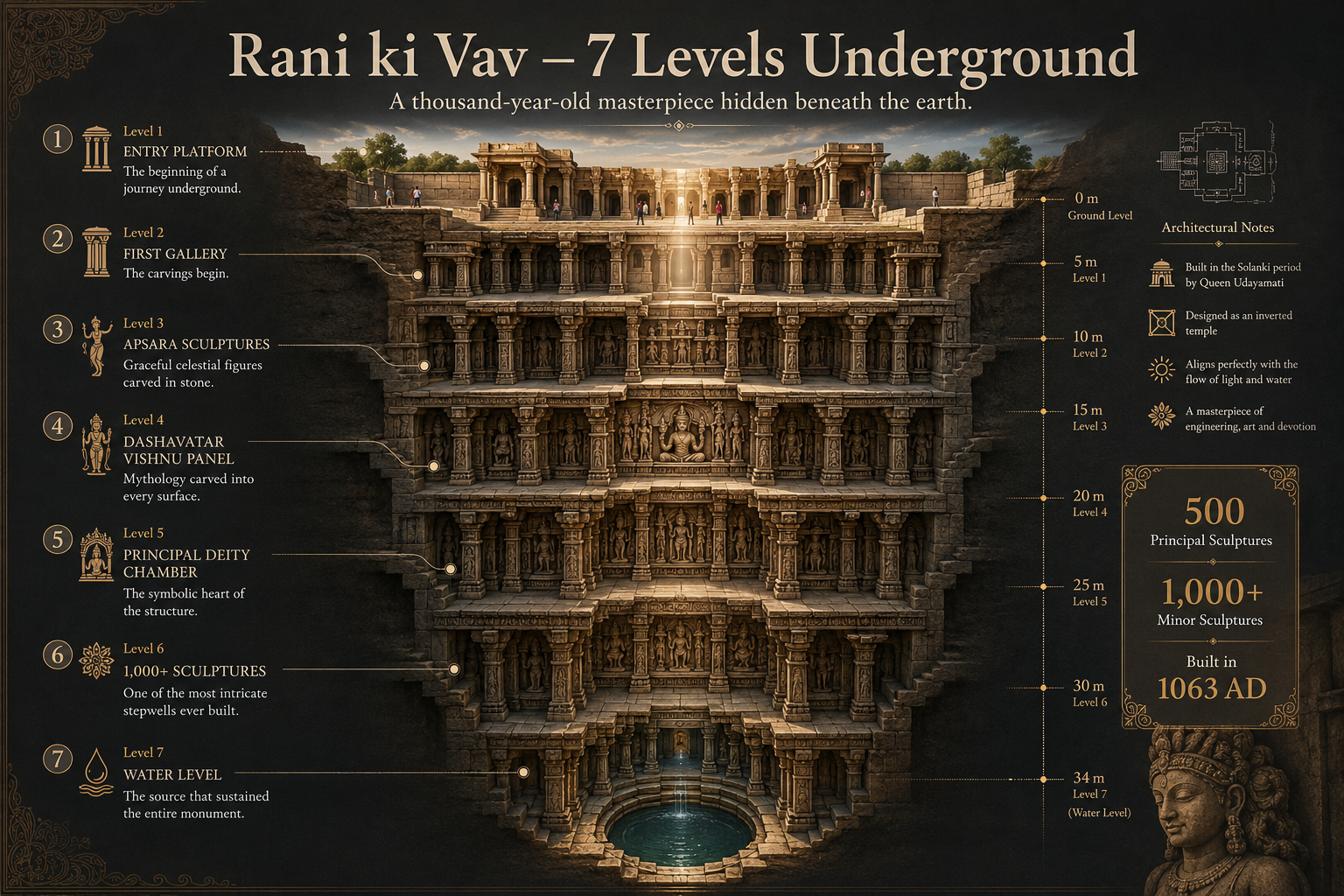
Rani ki Vav - literally "The Queen's Stepwell" - was built in 1063 AD by Queen Udayamati as a memorial to her husband, King Bhimdev I of the Solanki dynasty. It descends seven storeys underground in an inverted temple form. And every wall, every column, every surface on all seven levels is covered with sculptures.
Not decorative carvings. Not simple patterns. Full, detailed sculptures - of gods, celestial beings, royal figures, apsaras, and mythological scenes - 500 principal sculptures and over 1,000 minor ones, carved with a precision that genuinely makes you stop and wonder how human hands did this without modern tools.
The stepwell was buried under silt for centuries - probably submerged during a flood of the Saraswati River. When archaeologists excavated it in the 1980s, the carvings were found largely intact, preserved by the very silt that had hidden it. Uncovering Rani ki Vav must have felt like opening a time capsule.
Today it stands as arguably the finest example of Maru-Gurjara architecture in existence. The Archaeological Survey of India featured one of its iconic Vishnu sculptures on the back of the ₹100 note — so you've probably seen a detail from it without realising.
Most tourists who visit Gujarat never come here. Patan is only about 130 km from Ahmedabad - easily a day trip. And the stepwell complex is rarely crowded.
Combine with: Modhera Sun Temple (30 km away) for a full North Gujarat heritage day.
Best time: Year-round. October–March is most comfortable.
Best for: History lovers 🏛️ · Photographers 📷 · Architecture enthusiasts · Couples 💑
4. Modhera Sun Temple - Built So Precisely, the Sun Does the Rest
About 100 km from Ahmedabad, the town of Modhera is home to a temple that has been quietly astonishing visitors since 1026 AD.
The Modhera Sun Temple was built by King Bhima I of the Solanki dynasty and dedicated to Surya - the sun god. It is a masterpiece of Maru-Gurjara architecture: the same school that produced Rani ki Vav, Dilwara temples, and Ranakpur. The carvings that cover every surface of the main hall are so dense and detailed that first-time visitors typically spend 20 minutes standing in one spot trying to process what they're looking at.
But the thing that makes Modhera genuinely extraordinary isn't the carvings - it's the engineering.
The temple was built with such astronomical precision that on the spring and autumn equinoxes (March 21 and September 23), the first rays of the rising sun fall directly on the idol inside the sanctum. On the summer solstice, the sun is directly overhead at noon and casts no shadow on the main hall. This wasn't an accident. It required a level of astronomical knowledge and architectural precision that still makes architects and historians pause.
In front of the main temple is the Surya Kund - a large, intricately designed stepwell with 108 miniature temples built into its sides at regular intervals. Standing on its edge and looking down at the geometry of it - the steps descending symmetrically on all four sides, each one carved - is a specific visual experience that photographs don't fully convey.
Every January, the Uttarardh Mahotsav dance festival transforms the temple into a stage - classical Indian dancers performing against the 1,000-year-old stone backdrop. One of Gujarat's most extraordinary cultural events.
Getting there: ~100 km from Ahmedabad, about 1.5 hours.
Combine with: Rani ki Vav in Patan (30 km) for a heritage day.
Best time: Year-round. Visit at sunrise for the full effect.
Best for: History lovers 🏛️ · Architecture enthusiasts · Photographers 📷 · Families 👨👩👧

5. Nal Sarovar - Flamingos, Silence, and 90 Minutes from Ahmedabad
If you live in or near Ahmedabad and haven't been to Nal Sarovar, you've been missing something remarkable within easy reach.
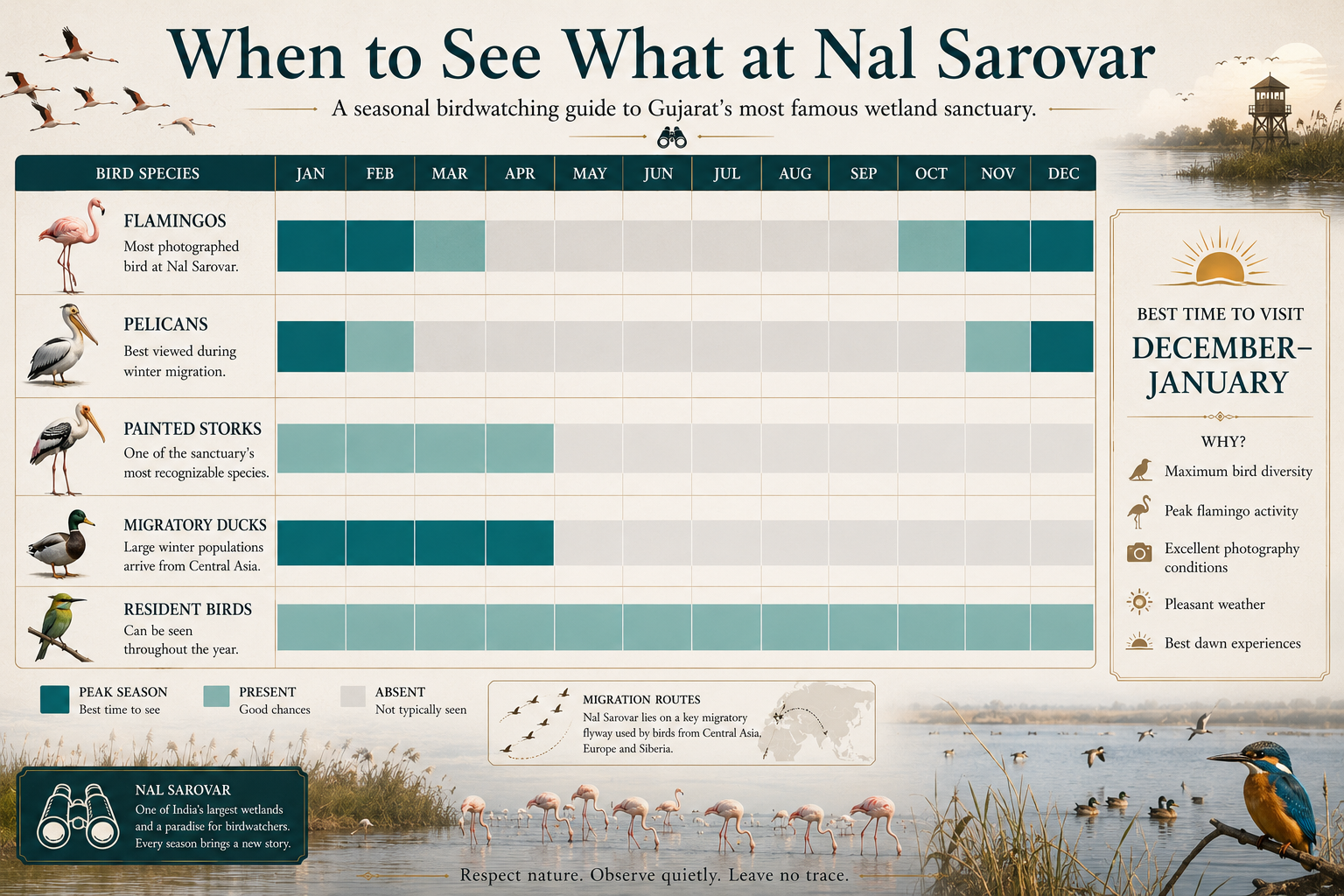
Nal Sarovar Bird Sanctuary sits about 60 km southwest of Ahmedabad - roughly 90 minutes by road. It is one of the largest bird sanctuaries in India, centered around a vast, shallow lake that becomes a seasonal paradise for waterbirds between November and February.
The numbers here are not small. The sanctuary regularly hosts over 250 species of resident and migratory birds. At peak winter season, you'll find flamingos, pelicans, painted storks, spoonbills, purple herons, cranes, and dozens of duck species - all in the same frame, if you're patient enough to sit quietly with binoculars.
The experience of being here at dawn is something specific. The lake is completely still, reflecting the early pink sky. The birds are active - feeding, calling, moving. Wooden boats are the only way to get around the sanctuary, and the boatmen who operate them have spent years learning where different species gather. A good boatman here is worth more than any guide.
The sanctuary is also home to several migratory species that travel thousands of kilometres from Central Asia and Siberia to spend winter here. The idea that a flamingo you're watching a few hours from Ahmedabad may have flown from the edge of Russia is - if you let yourself think about it - genuinely astonishing.
Getting there: ~60 km from Ahmedabad, about 90 minutes by road. Nearest town is Sanand.
Best time: November to February for peak bird activity. Dawn visits are significantly better than afternoon.
Important: Hire a registered boatman from the forest department - they know the bird locations and the boat routes far better than private operators.
Best for: Birdwatchers 🦅 · Families 👨👩👧 · Photographers 📷 · Anyone who needs a calm day out of the city.
6. Wankaner - A Forgotten Royal Town That Time Left Behind
The name itself is a clue. Wankaner comes from two Gujarati words - wanka (bend) and ner (river). The town sits exactly on a bend of the Machhu River in Saurashtra, and has sat there, unhurried and largely unvisited, for centuries.
It was the seat of the Jhala Rajput royal family - a dynasty that ruled this region since 1605. It was never a major tourist destination. It doesn't have a famous fort or a famous temple. What it has is something rarer: an intact, atmospheric royal town that genuine tourism almost entirely missed.
The Ranjit Vilas Palace is the centrepiece - and it carries a story most people don't expect.
Construction began in 1907 under Maharana Amarsinhji, the last ruler of Wankaner. He named the palace after his close friend - Jam Ranjitsinhji of Nawanagar, the famous cricketer who captained Sussex and played for England. A Gujarat royal, a cricket legend, a palace named in his honour. That unexpected connection - Saurashtra, royalty, and English cricket in one building - says something about the layered, surprising history of this region.
The palace itself sprawls across 225 acres on a hilltop above town, with a watchtower that gives a 360-degree view of the Machhu River valley below. The architecture is a confident mix of Venetian Gothic, Italianate, Mughal, and Rajput styles - a clock tower here, carved jharokha windows there, grand arches that feel somehow both European and completely Gujarati. It should be chaotic. It isn't.
Parts of the palace remain a private royal residence. A section has been converted into a heritage hotel - meaning you can actually sleep inside a functioning royal palace. This is not a museum experience. The family still lives here.
The town around the palace rewards exploration. The older havelis, the quiet riverfront ghats, the bazaars - this is what Rajasthan's heritage towns looked like before tourism arrived. Wankaner just never had that moment. Which is your gain.
Getting there: 55 km from Rajkot, ~230 km from Ahmedabad. Accessible by road or a short train from Rajkot.
Best time: October to March.
Stay option: Ranjit Vilas Palace Heritage Hotel - a royal palace stay at a fraction of comparable Rajasthan prices.
Best for: Couples 💑 · Heritage travellers · Photographers 📷 · History lovers 🏛️ · Anyone who loves Rajasthan but wants it without the crowds.
How to Combine These into a Real Trip
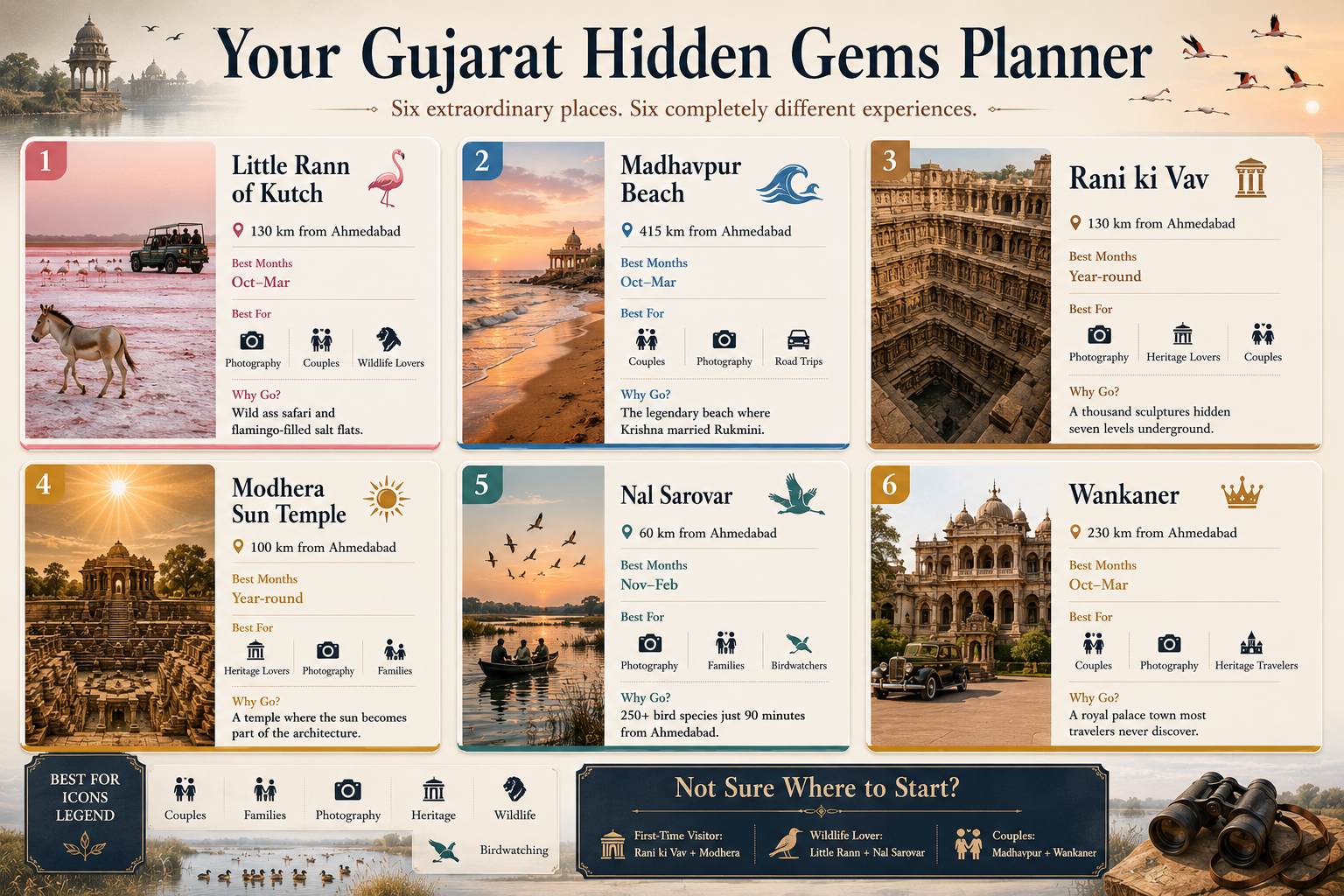
None of these destinations needs a separate dedicated trip. They fit naturally into three different Gujarat circuits — each one geographically logical, without unnecessary backtracking.
Circuit 1 — North Gujarat Heritage Day (1 day from Ahmedabad) Ahmedabad → Modhera Sun Temple (110 km, ~2 hrs) → Rani ki Vav, Patan (36 km, ~45 min) → Ahmedabad return Total driving: ~290 km
Both sites are from the same Solanki dynasty, in the same direction northwest of Ahmedabad, and together make one of the finest single-day heritage experiences in Gujarat. Leave by 7 AM, back by 9 PM. No overnight stay needed.
Circuit 2 — Little Rann Wildlife Weekend (2 days from Ahmedabad) Day 1: Ahmedabad → Dasada or Zainabad (~100 km, ~2 hrs) → afternoon jeep safari → overnight at eco-camp Day 2: Dawn safari (best light, best wildlife sightings) → return to Ahmedabad Total driving: ~200 km return
The dawn safari on Day 2 is the real reason to stay overnight — wild ass sightings are significantly better in early morning light. Nal Sarovar is in the opposite direction from Ahmedabad and doesn't fit this route. Do it on a separate half-day trip on its own.
Circuit 3 — Saurashtra Coastal Road Trip (3–4 days) Ahmedabad → Wankaner (230 km) → Rajkot (55 km) → Madhavpur Beach (191 km) → Somnath (73 km) → Gir National Park (57 km) → Ahmedabad return (~320 km) Total driving: ~926 km
All stops flow in one natural arc through Saurashtra — no doubling back, no direction conflicts. Wankaner and Rajkot on Day 1, coastal drive to Madhavpur and Somnath on Day 2, Gir safari on Day 3, return on Day 4. One of the most satisfying road trips Gujarat offers.
Frequently Asked Questions (FAQ)
Q1. What are the best hidden places in Gujarat for a first-time visitor? For first-time visitors to Gujarat looking beyond the main circuit, the top hidden gems are Little Rann of Kutch (wild ass and flamingos, 130 km from Ahmedabad), Rani ki Vav in Patan (UNESCO stepwell, 130 km), Modhera Sun Temple (100 km), and Nal Sarovar Bird Sanctuary (60 km). All four can be combined into a 2-day North Gujarat circuit.
Q2. What is the Little Rann of Kutch and how is it different from the Great Rann? The Little Rann of Kutch is a 4,953 sq km salt desert and wildlife sanctuary in central Gujarat, distinct from the more famous Great Rann. While the Great Rann is known for its white salt flat experience and Rann Utsav festival, the Little Rann is a wildlife sanctuary - home to the world's last population of Indian Wild Ass and thousands of flamingos that turn the salt flats pink in winter.
Q3. Is Rani ki Vav worth visiting in Gujarat? Absolutely. Rani ki Vav in Patan is a UNESCO World Heritage stepwell built in 1063 AD with over 500 principal sculptures and 1,000 minor carvings across seven underground levels. It is one of India's finest examples of Maru-Gurjara architecture and among Gujarat's most undervisited major monuments. It is 130 km from Ahmedabad and easily done as a day trip combined with Modhera.
Q4. What is special about Modhera Sun Temple? The Modhera Sun Temple, built in 1026 AD, is architecturally aligned so that on the spring and autumn equinoxes, the first rays of the rising sun fall directly on the idol inside the sanctum. The temple is covered with intricate carvings, and the Surya Kund stepwell in front features 108 miniature temples. It is 100 km from Ahmedabad and one of India's most precise examples of ancient astronomical architecture.
Q5. What is Madhavpur Beach known for? Madhavpur Beach near Porbandar is believed to be the site where Lord Krishna married Rukmini, according to Hindu mythology. It is a clean, uncrowded beach with a 15th-century temple dedicated to this union. Every year in March-April, the Madhavpur Mela celebrates the occasion with tribal dances, folk music, and cultural performances - uniquely involving communities from both Gujarat and Northeast India.
Q6. Is Nal Sarovar worth visiting from Ahmedabad? Yes - Nal Sarovar is one of the most accessible and underappreciated day trips from Ahmedabad. Located just 60 km away (~90 minutes), the bird sanctuary hosts 250+ species including flamingos, pelicans, painted storks, and numerous migratory birds. Dawn visits between November and February offer the best experience. Only wooden boats operated by registered forest department boatmen are allowed inside the sanctuary.
Q7. Can I stay at Wankaner Palace? Yes. Parts of the Wankaner Palace - the royal residence of the Jhala Rajput dynasty in Saurashtra - have been converted into a heritage hotel. It offers a genuine royal palace stay at significantly lower prices than comparable heritage properties in Rajasthan. Wankaner is about 55 km from Rajkot and 230 km from Ahmedabad.
Final Thought
The most surprising thing about Gujarat isn't what people know about it.
It's everything they don't.
Somewhere between a pink desert, a forgotten palace, a thousand-year-old stepwell, and a beach tied to mythology, there's a version of Gujarat most travellers never meet.
Now you know where to find it.
Planning a Gujarat Trip?
Tell Yatray where you're starting from, your budget, and how many days you have.
We'll create a personalised itinerary with stays, experiences, and local recommendations - in minutes.